
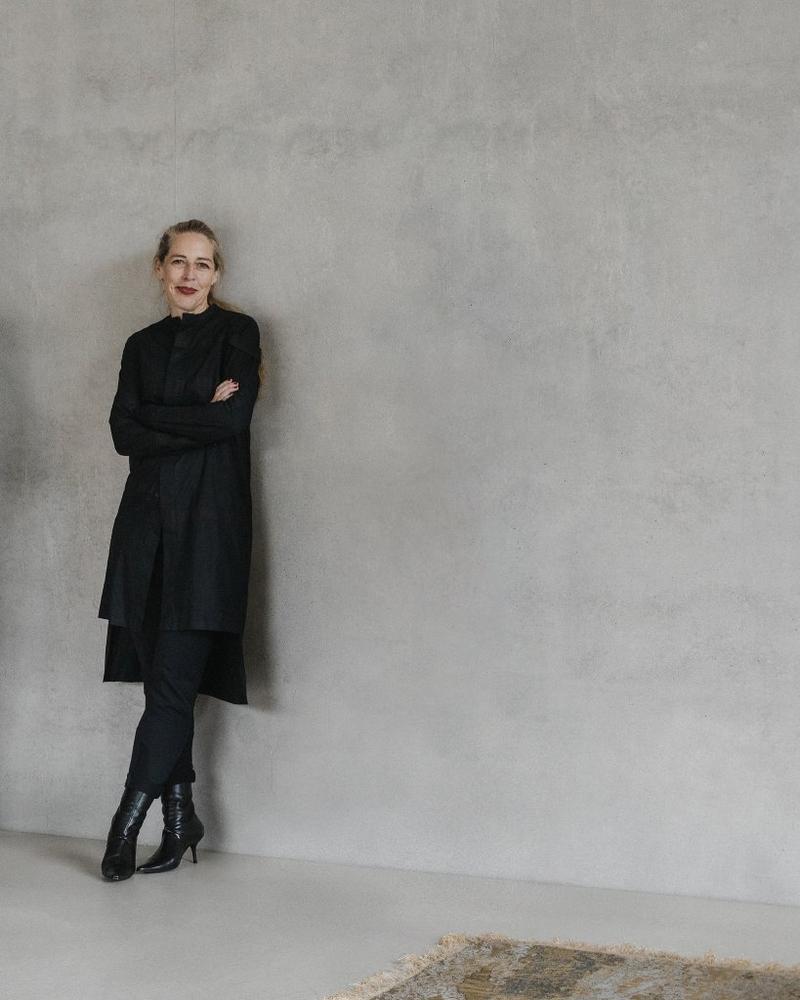
Anna Philipp knows this silence well. As the creative mind behind Philipp Architekten, the award-winning practice she leads from studios in a castle in Waldenburg, a studio in Frankfurt, and an atelier near Zurich, she has spent decades listening for it — and building around it.
"People walk into one of our houses and they feel something they can’t quite name," she says, sitting in her Waldenburg studio where afternoon light falls across samples of hand-finished lime plaster and locally quarried stone. "They’ll say: This feels different. What they’re sensing is time — the time a craftsperson invested in every joint, every texture, every surface. That presence lingers. It becomes part of the atmosphere."
The Vanishing Hand
What makes this presence so precious is precisely what makes it so precarious. Across Europe, the artisanal trades that have shaped architecture for centuries are quietly disappearing. In Germany alone, more than 107,000 skilled craft positions remain unfilled — every second vacancy in the trades cannot be filled at all. The average time to fill a single craft position has more than doubled in less than a decade, from 104 days in 2015 to 224 days by 2024. Ornamental plasterers, master stonemasons, bespoke joiners, specialist weavers — the men and women who can conjure beauty from raw matter are retiring, and too few are following.
For Philipp, this is not an abstract policy problem. It is personal. "Every master who leaves without a successor takes a piece of our cultural memory with them," she says. "Techniques that took generations to develop vanish in a single retirement. And once they’re gone, no algorithm, no robot, no 3D printer can bring them back."
It is this urgency that has sharpened her conviction: in a world of infinite replication, the handmade has become architecture’s rarest material.
Building with Human Devotion
The philosophy at Philipp Architekten is disarmingly simple in its premise, exacting in its execution: treat craft not as embellishment but as the very DNA of a building. Materials here are never selected from a catalogue. They are found, tested, debated, sometimes custom-developed — a plaster mixed to capture a specific luminosity at dusk, a stone chosen for the way its veining catches low winter light, a textile woven to breathe with the rhythm of a particular room.
This is where collaborations become essential. Philipp has cultivated a network of artisans whose work she describes less as decoration and more as spatial authorship. Among them is Nathalie Van der Massen, the Belgian textile artist and Henry van de Velde Award laureate whose hand-woven pieces dissolve the boundary between fabric, architecture, and art. In Philipp Architekten’s residences, Van der Massen’s textiles are not hung on walls — they inhabit rooms, responding to light and movement the way a painting responds to the viewer’s gaze.
"I see my role changing," Philipp reflects. "The architect is no longer only a designer of space. She is a curator of human skill — finding the right hand for the right moment in a building’s story. That’s a responsibility I take as seriously as any structural calculation."
Slow as a Statement
In an industry measured in deadlines and delivery dates, Philipp Architekten has made an unlikely ally of slowness. A hand-laid stone floor takes weeks where a machine-cut version takes days. A bespoke lime render requires multiple coats, each one applied and left to cure before the next. The result is not merely aesthetic. It is haptic, atmospheric, emotional.
"Speed is the enemy of depth," Philipp says. "When a craftsperson spends three weeks on a floor that a machine could produce in three days, the difference is not efficiency — it’s soul. The time they invested becomes part of the material. You walk across it and you feel it, even if you don’t know why."
This conviction echoes through the firm’s celebrated Collectible Architecture concept — the pioneering approach that reimagines buildings as singular, unrepeatable works of art with the cultural weight and investment logic of collectible design or fine art. Where a mass-produced home depreciates, a Philipp Architekten residence accrues meaning, patina, and value with every passing year.
A World Catching Up
If Philipp’s philosophy once felt countercultural, 2026 has brought the mainstream to her door. The global design conversation has pivoted decisively toward the handmade, the tactile, the irreplaceably human. Forecasters from New York to Milan are calling it "The Return of the Hand". Quiet luxury — the idea that true refinement speaks through material honesty and artisanal integrity rather than logos or spectacle — has moved from whisper to roar across the pages of every major design publication.
"What the world is discovering now is what we have always known," Philipp says with a calm that comes from conviction rather than complacency. "The most luxurious thing you can offer anyone is not a rare marble or a famous name on the door. It is the evidence of human care. A home where you can see, touch, and live inside the devotion of extraordinary makers."
She pauses, then adds: "That is what we build. Every single time."
Philipp Architekten is a multi-award-winning architecture and interior design practice with studios in Waldenburg (Germany), Frankfurt am Main (Germany), and Zurich (Switzerland). Led by Anna Philipp — the eleventh generation of a long family building dynasty — the firm specializes in exclusive residential architecture, heritage restoration, and bespoke interior design. Philipp Architekten is the originator of the Collectible Architecture concept — a pioneering philosophy that treats buildings as unique, collectible works of art defined by the highest standards of craftsmanship, artistic vision, and material excellence.
"Beauty matters."
Philipp Architekten GmbH
Schlossstrasse 16
74638 Waldenburg
Telefon: +49 791 75990
http://www.philipparchitekten.de
Referentin für Marketing und Öffentlichkeitsarbeit
Telefon: 0791759925
E-Mail: nk@philipparchitekten.de
