
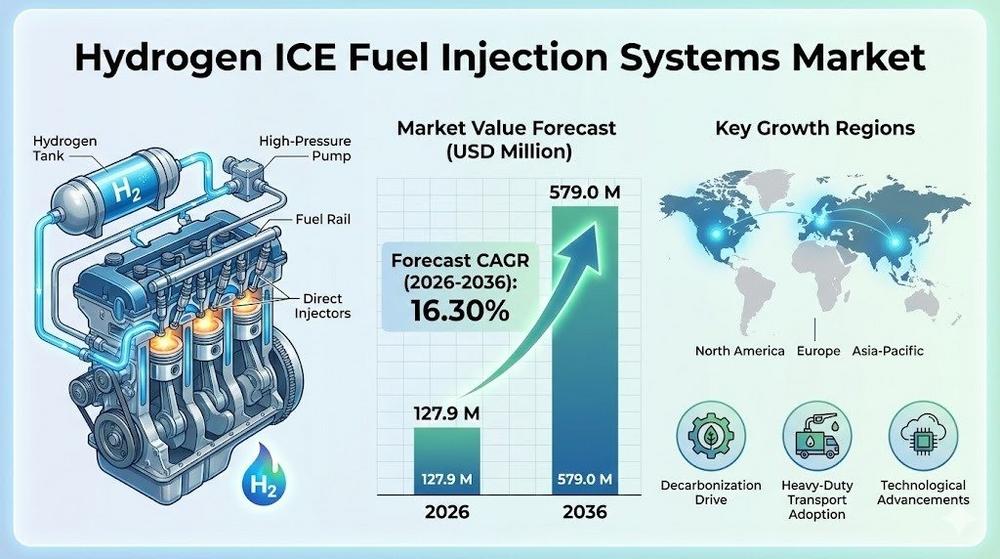
The global Hydrogen ICE Fuel Injection Systems Market is transitioning from pilot-stage deployment to structured commercialization as hydrogen-powered internal combustion engines gain acceptance across commercial, industrial, and niche passenger vehicle segments. The market is valued at USD 127.9 million in 2026 and is projected to reach USD 579.0 million by 2036, registering a strong CAGR of 16.3%. Growth is shaped by OEM-backed hydrogen engine programs, regulatory pressure to reduce emissions, and increasing confidence in hydrogen-compatible fuel delivery technologies.
Subscribe for Year-Round Insights → Stay ahead with quarterly and annual data updates
https://www.futuremarketinsights.com/reports/sample/rep-gb-30717
Growth Outlook: Value Expansion Driven by Precision and Validation
Between 2026 and 2031, the market is expected to grow from USD 127.9 million to USD 233.9 million, generating an absolute increase of USD 106 million. Approximately 70% of this growth is volume-driven, supported by adoption of injectors, rails, regulators, and pumps across heavy-duty, stationary, and marine engines. The remaining 30% is attributed to price growth, reflecting advanced component designs, pressure-class differentiation, and pilot-scale deployments.
From 2031 to 2036, market value is forecast to rise sharply from USD 233.9 million to USD 579.0 million, adding USD 347.6 million. Growth quality improves as early demonstration programs transition into early-series production. Suppliers with proven hydrogen injection performance, OEM partnerships, and scalable manufacturing capabilities are best positioned to capture this expansion.
Revenue Concentration: OEM Alignment Shapes Market Power
Revenue concentration in the hydrogen ICE fuel injection systems market is closely tied to participation in high-volume hydrogen engine programs. Suppliers integrated into OEM development cycles benefit from predictable demand, stable production schedules, and stronger pricing leverage. In contrast, smaller regional and aftermarket players face demand variability due to certification timelines, infrastructure constraints, and limited bargaining power.
Key characteristics defining revenue leaders include:
- Multi-platform certified injection systems
- Compliance with evolving hydrogen safety and emission regulations
- Technical support, calibration, and maintenance services
- Proven production reliability and supply predictability
Pressure Class Dynamics: Medium-Pressure Systems Lead Demand
By pressure class, medium-pressure systems (10–30 bar) represent the leading segment, accounting for approximately 36% of total demand. This range provides efficient hydrogen atomization while maintaining system durability and operational safety.
Key factors supporting dominance of the medium-pressure segment include:
- Compatibility with existing injector and fuel management technologies
- Stable performance under moderate engine loads
- Easier integration into passenger and light commercial ICE platforms
- Predictable maintenance and pressure stability
Manufacturers favor this pressure class as it balances performance, safety, and regulatory compliance, supporting broader adoption of hydrogen ICE technology.
Component Scope: Injectors Remain the Primary Value Driver
Injectors account for roughly 34% of total component demand, making them the largest and most critical segment. These components directly control hydrogen flow, injection timing, and spray pattern—factors essential for stable combustion and emission reduction.
Drivers of injector dominance include:
- Need for precise hydrogen metering and atomization
- High thermal and pressure resistance requirements
- Compatibility across multiple pressure classes and engine types
- Direct impact on engine efficiency, emissions, and reliability
Suppliers specializing in injector precision and durability capture higher margins due to the technical complexity and safety-critical nature of these components.
Regional Insights: Growth Mirrors Hydrogen Infrastructure Readiness
Market adoption varies significantly by region, reflecting differences in hydrogen infrastructure development and policy support.
- China (CAGR 18.7%): Leads global growth driven by government incentives, demonstration fleets, and hydrogen vehicle programs.
- Brazil (CAGR 18.3%): Growth supported by pilot projects, fleet modernization, and alternative fuel initiatives.
- United States (CAGR 15.7%): Expansion driven by R&D programs, commercial vehicle pilots, and sustainability targets.
- United Kingdom (CAGR 15.5%): Growth supported by hydrogen mobility policies and engine research initiatives.
- Japan (CAGR 14.5%): Established hydrogen strategy and strong OEM collaboration drive steady adoption.
Demand is concentrated in automotive manufacturing hubs, engine assembly plants, and hydrogen technology pilot projects rather than mass-market vehicle deployment.
Policy and Emissions: Structural Drivers of Demand
Stricter emission regulations and national hydrogen roadmaps are accelerating adoption of hydrogen ICE fuel injection systems. OEMs and fleet operators view hydrogen ICE technology as a transitional solution that leverages existing engine architectures while achieving lower CO₂ and NOx emissions. System selection prioritizes precision, durability, and safety compliance over cost minimization.
Competitive Landscape: Engineering Capability Defines Leadership
Competition is defined by hydrogen-specific materials, precision engineering, and system integration capabilities. Leading players include Bosch, Continental, Denso, Cummins, Parker Hannifin, Weifu High-Technology, Delphi (BorgWarner), Westport Fuel Systems, Hanwha, and Nikkiso. Competitive advantage is built on validated performance, OEM trust, safety certification, and scalable production rather than aggressive capacity expansion.
Market Outlook: Precision-Led Growth Through 2036
As hydrogen infrastructure expands and regulatory clarity improves, hydrogen ICE fuel injection systems will play a critical role in low-emission transport, particularly for commercial and industrial vehicles. Long-term success will depend on system precision, supply predictability, and deep OEM integration—positioning the market for sustained, high-quality growth.
Get data that aligns with your strategic priorities — ask for report customization today:
https://www.futuremarketinsights.com/customization-available/rep-gb-30717
Related Reports
Ground Recorder System Market – https://www.futuremarketinsights.com/reports/ground-recorder-system-market
Low-VOC Degreasers for Metalworking Market – https://www.futuremarketinsights.com/reports/low-voc-degreasers-for-metalworking-market
Laser Vibrometer Market – https://www.futuremarketinsights.com/reports/laser-vibrometer-market
Have a specific Requirements and Need Assistant on Report Pricing or Limited Budget please contact us – sales@futuremarketinsights.com
Future Market Insights, Inc. (FMI) is an ESOMAR-certified, ISO 9001:2015 market research and consulting organization, trusted by Fortune 500 clients and global enterprises. With operations in the U.S., UK, India, and Dubai, FMI provides data-backed insights and strategic intelligence across 30+ industries and 1200 markets worldwide.
Future Market Insights, Inc
Christiana Corporate, 200 Continental Drive, Suite 401,
USADelaware Newark,
Telefon: +1-347-918-3531
Telefax: +1 845 5795705
http://www.futuremarketinsights.com
Marketing
Telefon: +13479183531
E-Mail: Rahul.Singh@futuremarketinsights.com
