
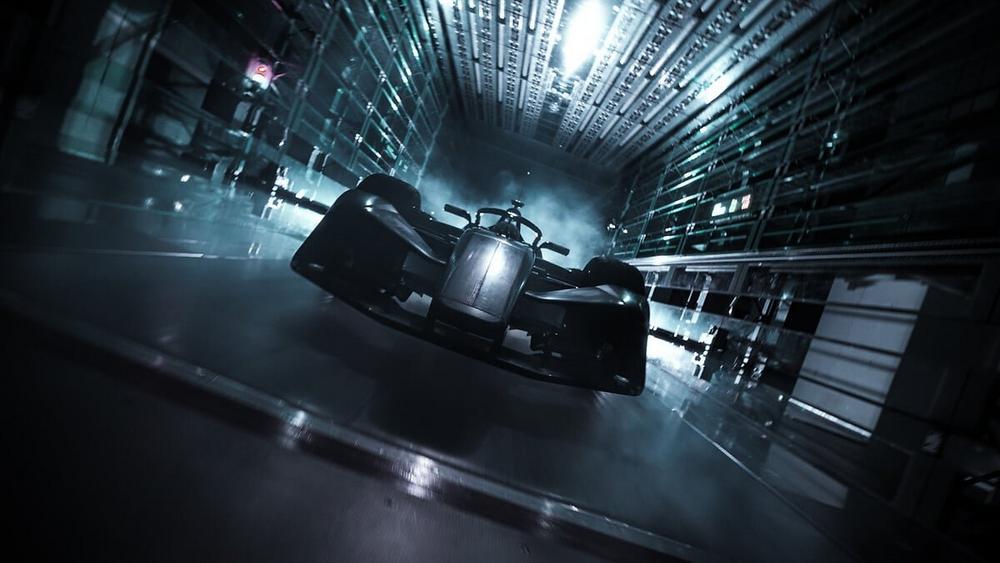
- Opel GSE Formula E Team prepares race cars in the wind tunnel for the demands of the new GEN4 era
- Aerodynamics are becoming increasingly important in the ABB FIA Formula E World Championship: Higher speeds and two aero configurations for the first time
- Wind tunnel provides precision data for balance, efficiency and vehicle setup
- Jörg Schrott: “We want to understand aerodynamics in detail under all conditions.”
With the new GEN4 era of Formula E starting next season, not only performance is increasing, but also the demand for even more precision and detail work. The next generation of vehicles will be significantly faster than its predecessors, and at the same time two different aerodynamic configurations will be used for the first time in Formula E. For Opel, it is therefore clear that in order to fully exploit the potential of the Opel GSE 27FE race car, the team must understand the aerodynamics of the vehicle down to the finest detail.
In the wind tunnel, the Opel GSE Formula E Team is working on precisely testing and analysing the behaviour of the race car under realistic conditions and thus preparing the test programmes on the track even more precisely. In this way, a range becomes tangible that can later decide on stability, efficiency and, at the limits, also on every hundredth of a second.
“The GEN4 era is taking the importance of aerodynamics to a whole new level,” said Jörg Schrott, Team Principal of the Opel GSE Formula E Team. “That’s why we want to understand very precisely how the different configurations behave and how we can use the data obtained in the best possible way for further development and subsequent setup.”
Perfect timing: Opel enters Formula E at the beginning of a new era
The new Formula E generation significantly raises the performance level: instead of the previous 350 kW (476 hp), the GEN4 car has an output of 600 kW (816 hp), features permanent all-wheel drive and will accelerate from 0 to 100 km/h in under two seconds. These performance values as well as two different aero configurations significantly change the requirements. While one configuration is designed for the lowest possible air resistance in the race, the other one delivers more downforce for fast laps in qualifying rounds.
For the teams, this means that they need in-depth knowledge of both variants and require precise measurements of the corresponding values. The wind tunnel is enormously valuable in this phase because the values obtained are close to real life – and cannot be measured on the track with this accuracy.
Super sports car: This is how the Opel GSE 27FE ‘trains’ in the wind tunnel
In the wind tunnel, the Opel GSE 27FE is examined under conditions that simulate its use on the track as realistically as possible. Whilst the car is on the conveyor belt, air flows over the vehicle at a set speed. This allows the engineers to measure exactly how the airflow affects the front and rear, how the balance changes and how the respective configuration works.
For direct comparison, the team swaps front and rear wings during the sessions to switch between the two aero configurations. The advantage: Both variants can be evaluated under the same conditions. This helps the engineers to check simulations and then continue working with reliable measured values.
“We measure aerodynamic loads such as the balance of downforce with very high accuracy in the wind tunnel,” explained Simon Merchet, Head of Development Formula E Project. “On the track, we only see bigger effects, but not the fine details with the same precision. It is precisely these clean values that we need in order to continue working with reliable foundations later.”
Perfectly coordinated: Opel preparation follows a precise plan
The fact that Opel has already tested in the wind tunnel before the intensive track tests is part of a clear development plan. The development chassis was already available, while the new powertrain was not yet ready for the track at that time. The team used this phase to further develop the aerodynamics in parallel. As soon as the powertrain was available, the focus shifted more to the track. Wind tunnel, test bench, simulator and test drives are deliberately intertwined. “We have a clear plan, and this plan is being worked through,” said Jörg Schrott.
Optimum aerodynamics: Know-how also for series production
Successful work in the wind tunnel has a long tradition at Opel: The legendary Calibra already set standards at its market launch in 1989 with a cW value of 0.26 and was considered the most aerodynamically efficient production car in the world at the time. Opel also dealt with the interaction of air resistance and cooling in motorsport at an early stage – for example, in 1996 in the Calibra V6 4×4 for the DTM (German Touring Masters) and ITC with active aeroshutters in the front area.
The importance of aerodynamics at Opel is also demonstrated by current models: With a drag coefficient of cW=0.29, the Opel Corsa is one of the most aerodynamic vehicles in its segment, while the Opel Mokka achieves a cW value of 0.32 and is therefore also one of the best in its class. In both models, active radiator blinds help to control the airflow in a targeted manner depending on the driving situation and cooling requirements, thus improving efficiency.
Opel Automobile GmbH
Bahnhofsplatz 1
65423 Rüsselsheim
Telefon: +49 (6142) 7-70
Telefax: +49 (6142) 77-8409
http://de-media.opel.com/de
Communications, Manager International Product
Telefon: +49 (6142) 69-22084
E-Mail: colin.yong@stellantis.com
Telefon: +49 (6142) 6921679
E-Mail: matthias.meyer@opel-vauxhall.com
