
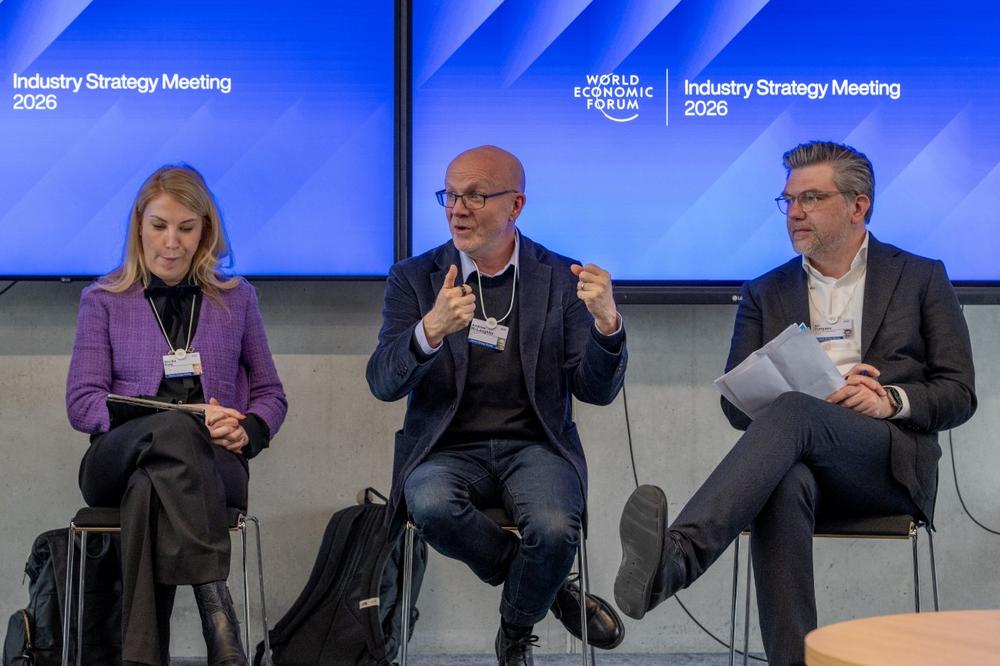
TUM Campus Heilbronn was prominently represented in the Bavarian capital by its Vice President, Prof. Ali Sunyaev. With this, TUM Campus Heilbronn continued its engagement in the WEF network following two previous participations in AI House Davos, held alongside the World Economic Forum. TUM was further represented by its President, Prof. Thomas Hofmann; Prof. Christoph Kaserer (Dean of the TUM School of Management); Prof. Urs Gasser (Dean of the TUM School of Social Sciences and Technology); Prof. Svetlana Ikonnikova (Professor of Resource Economics and Research Director at the TUM Center for Energy Markets); and Prof. Isabell Welpe (Professor of Strategy and Organization).
Growing Need for Trust
Key trends were also discussed in the panel “Attention Economy: Strategy Dialogue for Travel, Tourism, Media, & Sport Leaders,” moderated by Prof. Sunyaev. The discussion focused on how modern technologies and human behavior interact. “How does IT influence our behavior?” Sunyaev asked, noting: “Often, a battle for attention arises, where it is about who is the loudest and tells the best story.” At the same time, people are reading less, as bots increasingly provide summaries of texts. “Even as a scientist, I cannot read everything and often have to rely on specific journals or conferences,” he added. This makes trust all the more important: “This is a socio-technical phenomenon—we also evaluate AI based on whether it can be trusted.”
The panelists agreed that, given the profound changes in work, markets, and consumption driven by artificial intelligence, AI competence, targeted use, and clear rules are becoming increasingly important. As AI agents interact directly with customers and make decisions, traditional marketing is losing relevance, and companies must communicate their value proposition clearly and in a data-driven way. At the same time, a growing volume of AI-generated content is making it increasingly difficult to distinguish between what is real and what is artificial—raising the importance of trustworthy brands and technical solutions for content verification. In parallel, the demand for real-world experiences and social interaction is increasing as a counterbalance to the digital world.
From Language Models to Physical AI
The panel “Physical AI for Value Creation,” also moderated by Sunyaev, highlighted both the potential and the responsibilities associated with technological innovation. “Today, there is hardly any scientific work that has not been supported by an LLM. We have reached this point in just three to four years,” Sunyaev noted.
The next technological leap is already emerging: from language models to Physical AI—the application of AI in real-world, physical systems. The panelists identified key goals such as the intelligent control of machines and production facilities, increasing asset value, and enabling more sustainable operations. A crucial prerequisite is the responsible handling of sensitive data—for example, processing it locally while ensuring data sovereignty.
Valuable Insights and Future Commitment
Particularly promising is the combination of modern language models with traditional data models, as well as the integration of physical and contextual data that explain the conditions under which the data is generated. Falling costs are enabling broader adoption—despite ongoing regulatory challenges.
The two-day event provided valuable insights, highlighting both the immense potential of technologies such as AI and the challenges associated with their implementation. “We are delighted to have been part of this high-profile event and are taking away many valuable insights that we will incorporate into our collaborations with the regional economy in Heilbronn-Franken and beyond,” Sunyaev said. “We will continue to be actively involved in the WEF network in the future.”
Die TUM Campus Heilbronn gGmbH
Bildungscampus 2
74076 Heilbronn
Telefon: +49 (0) 7131 264180
Telefax: +49 (7131) 645636-27
https://www.chn.tum.de/de
Telefon: +49 (7131) 26418-501
E-Mail: Kerstin.Besemer@tumheilbronn-ggmbh.de
