
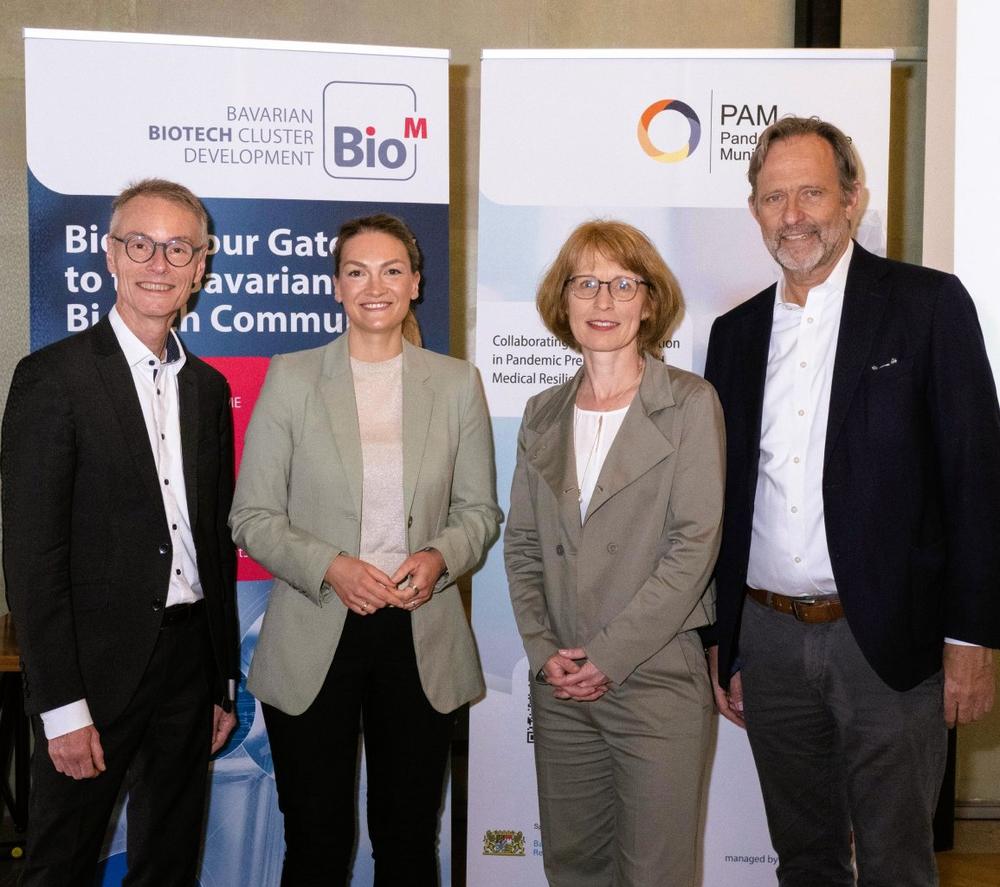
The event brought together leading national experts, including representatives from Roche, the Robert Koch Institute, the Bundeswehr, Fraunhofer, Helmholtz Munich, both Munich universities, and other key organizations in the fields of infectious disease research and healthcare innovation.
Following opening remarks by BioM Managing Director Prof. Ralf Huss, Bavaria’s Minister of Health and Prevention Judith Gerlach opened the event with a policy statement on the importance of proactive healthcare.
Gerlach emphasized the critical role of the healthcare sector during crises and explained: “We must set up the healthcare system so that it continues to function even in emergencies. This can only be achieved by working together. Bavaria is leading the way in this regard and is making targeted investments in innovative structures and partnerships. We have a close alliance and a strong network of expertise. Our goal is clear: We want to be as prepared as possible to protect people’s health even in future crises.”
The event showed that effective pandemic prevention can only succeed through an integrated combination of prevention, surveillance, and rapid response capabilities. Bavaria is contributing to this effort both through its strength as a leading research hub and through targeted initiatives.
Key messages for the future design of healthcare and resilience can be derived from the discussions:
- Pandemics do not respect borders: international health protection is national health protection – nobody is safe until everyone is safe.
- We must adopt dual-use strategies to ensure that prevention, diagnostics, therapeutics, and surveillance are crisis-ready – pandemic preparedness is not optional, especially in times of geopolitical challenges.
- Research, development, and production need to be independent from third countries and global supply chains.
- Clear responsibilities and governance are crucial, alongside more speed, more money, and less bureaucracy.
- Environmental factors matter for public resilience. If ignored, it affects public health and increases healthcare costs.
- Building trust requires training of communicators, medical staff, and the broader population.
- We have to build bridges by aligning language, data, structures, and activities across borders.
The focus was on current European and national strategies for pandemic prevention, as well as the role of regional initiatives. The event highlighted key Bavarian projects such as the Pandemic Alliance Munich (PAM), the Bavarian Center for Preventive Infectious Medicine (BZI), the Bavarian Competence Center for Health Protection in the Context of Climate Change, and the Bavarian Health Cloud (BHC). These initiatives exemplify how Bavaria is pooling its strengths in research, translational medicine, and digitalization in the health sector.
Another key focus was on how cross-sectoral collaboration can be strengthened. In interactive discussion formats, participants exchanged views on the necessary framework conditions for innovation in healthcare – ranging from data infrastructure and regulatory aspects to financing and international cooperation.
Regina Bach, Project Coordinator for the Pandemic Alliance Munich at BioM, explained: “The discussions made it clear: innovative approaches, cooperation, and coordination are crucial for preparing for future pandemic events. With the Pandemic Alliance Munich, we are bringing these elements together to prepare specifically for future pandemic events.”
The event’s strong reception and intense discussion underscore the urgent need for action – and, at the same time, the strong willingness of all stakeholders to work together on solutions.
Pandemic Alliance Munich (PAM)
The Pandemic Alliance Munich (PAM) is a public-private initiative coordinated by BioM and funded by the Bavarian State Ministry of Economic Affairs, Regional Development, and Energy to prepare for future pandemics and infectious disease outbreaks. It connects stakeholders from research, clinical settings, SMEs, and industry to pool interdisciplinary expertise and drive innovation throughout the entire pandemic cycle – from prevention and early detection to diagnostics, treatment, and implementation. The goal is to strengthen the scientific, technological, and organizational foundations for a rapid and coordinated response to health threats through close collaboration.
More information: www.bio-m.org/pandemic-alliance-munich
BioM has been the network organization for the biotechnology industry in Munich and Bavaria for over 25 years on behalf of the Bavarian Ministry of Economic Affairs.
BioM supports the Bavarian biotechnology and pharmaceutical industry with an extensive network for the initiation of new business contacts. The cluster management offers interested parties from Germany and abroad centralized access and a wide range of information about the industry.
BioM provides comprehensive advice and special coaching, training and mentoring programs especially for prospective company founders. With its incubator MAxL (Munich Accelerator Life Sciences & Medicine), BioM also offers optimal conditions for pre-seed projects and early-stage start-ups in the biotech and healthtech sector. BioM has also been coordinating the m4 Award pre-seed competition in the field of biomedicine since 2011, which is funded by the Bavarian Ministry of Economic Affairs. In total, BioM has supported over 250 start-ups.
In addition, BioM organizes a wide range of training courses, events and network meetings.
More information: www.bio-m.org
BioM Biotech Cluster Development GmbH
Am Klopferspitz 19a
82152 Martinsried
Telefon: +49 (89) 899679-0
Telefax: +49 (89) 899679-79
http://www.bio-m.org
Marketing & Communications Lead
Telefon: +49 (89) 899679-15
E-Mail: klingner@bio-m.org
PR & Social Media Manager
Telefon: +49 (89) 899679-39
E-Mail: proll@bio-m.org
