
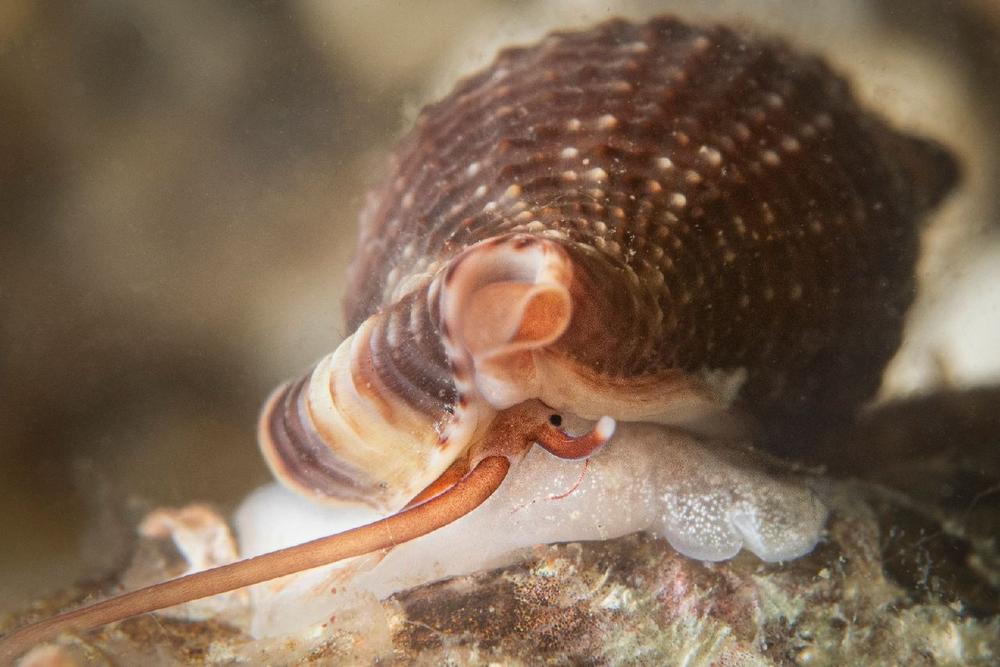
The vampire snail Cumia intertexta received a total of 5,506 votes in the online poll for “Mollusc of the Year 2026,” securing the title ahead of the rock-eating shipworm Lithoredo abatanica, the giant horse snail Triplofusus giganteus from Florida, the “winged” moon cockle Ephippodonta lunata, and the Seychelles white snail Filicaulis seychellensis. In total, the candidates received 15,096 clicks in the competition. Native to the southern Mediterranean, the vampire snail sucks the blood of fishes, which it hunts at night in shallow water. Measuring just two centimeters in size, this mollusc is the only Mediterranean member of a small group of vampire gastropods found around the world.
The tiny sea snail was nominated for the title of “International Mollusc of the Year 2026” by Dr. Maria Vittoria Modica of the Anton Dohrn Zoological Station in Italy. “The vampire snail is an amazing creature,” Modica reports. “During the day, it sleeps among coastal rocks and only begins hunting after sunset. It picks up the scent of a resting fish nearby, approaches it as closely as possible, and pierces its skin with a tiny but sharp radula at the tip of its extremely long proboscis. It then feeds on the fish’s blood while secreting a cocktail of blood thinners and anesthetics to keep its prey calm. Once it has had its fill, it retreats to its hiding place, leaving behind a stunned but otherwise healthy fish. I am delighted that this tiny vampire has been chosen as the ‘International Mollusc of the Year 2026’!”
To better understand the unusual lifestyle of the blood-sucking sea snail, the genome of Cumia intertexta is now being fully sequenced for the first time at Senckenberg—the reward for winning the title. “By sequencing the vampire snail’s genome, we will obtain the first genetic blueprint for blood feeding in molluscs,” explains Dr. Carola Greve, Head of the Laboratory Center for Biodiversity Genomics at the Senckenberg Research Institute and Natural History Museum in Frankfurt. “This will allow us to better understand how this feeding strategy evolved and how similar strategies arise in very different animal groups. Molluscs are the second-most species-rich animal group in the world, displaying a fascinating diversity. At the same time, the genomes of only a relatively small number of molluscs have been fully sequenced to date. We want to contribute to narrowing this gap and continually expanding our understanding of the genomic characteristics of these extraordinary animals.”
After a jury of researchers from Senckenberg and Unitas Malacologica selected five species for the final round from around 30 nominations submitted by the international mollusc community, all mollusc lovers were able to vote online for their favorites from April 13 to 26.
“We are thrilled that mollusc enthusiasts from all over the world have once again participated in the contest this year!” adds Prof. Dr. Julia Sigwart, Head of the Department of Marine Zoology at the Senckenberg Research Institute and Natural History Museum in Frankfurt. “A heartfelt thank-you to all the researchers who nominated such wonderful candidates and to all the mollusc fans who took part in the voting. The selection of the ‘Mollusc of the Year’ is a fantastic opportunity to raise awareness of this fascinating—and, sadly, often endangered—group of animals. Our goal is to gain a deeper understanding of these impressive creatures so that we can better protect them and preserve their diversity for future generations.”
The Senckenberg Gesellschaft für Naturforschung (Senckenberg Nature Society), a member institution of the Leibniz Association, has studied the “Earth System” on a global scale for over 200 years – in the past, in the present, and with predictions for the future. We conduct integrative “geobiodiversity research” with the goal of understanding nature with its infinite diversity, so we can preserve it for future generations and use it in a sustainable fashion. In addition, Senckenberg presents its research results in a variety of ways, first and foremost in its three natural history museums in Frankfurt, Görlitz, and Dresden. The Senckenberg natural history museums are places of learning and wonder and serve as open platforms for a democratic dialogue – inclusive, participative, and international. For additional information, visit www.senckenberg.de.
Senckenberg – Leibniz Institution for Biodiversity and Earth System Research // Senckenberg Gesellschaft für Naturforschung
Senckenberganlage 25
60325 Frankfurt
Telefon: +49 (69) 7542-0
Telefax: +49 (69) 746238
http://www.senckenberg.de
Senckenberg Research Institute and Natural History Museum Frankfurt
Telefon: +49 (69) 7542-1272
E-Mail: julia.sigwart@senckenberg.de?
Senckenberg Research Institute and Natural History Museum Frankfurt
Telefon: +49 (69) 7542-1844
E-Mail: carola.greve@senckenberg.de
Press Office Senckenberg Gesellschaft für Naturforschung
Telefon: +49 (69) 7542-1595
E-Mail: pressestelle@senckenberg.de
