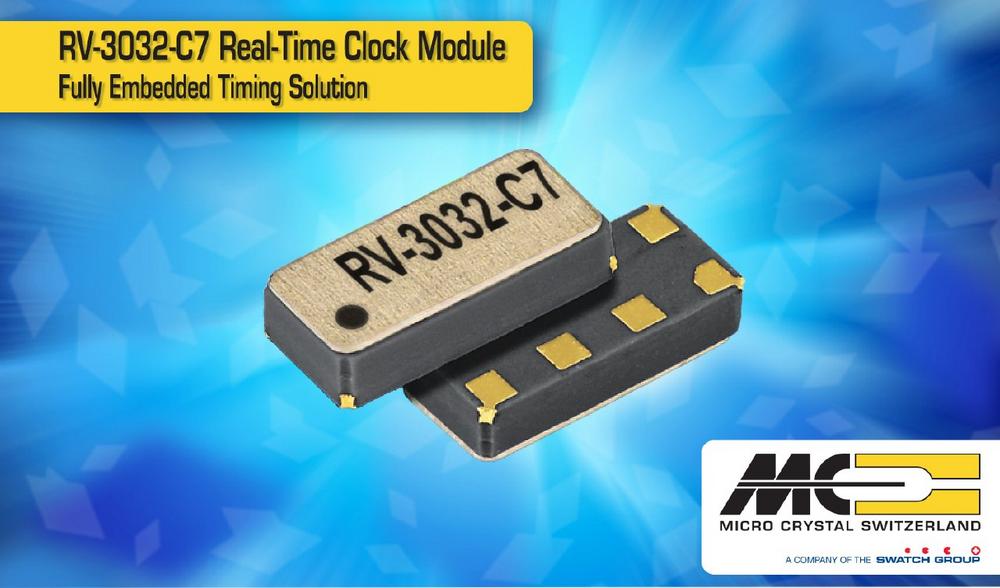
Enhancing Cyber Resilience with Real-Time Clock (RTC) Modules for Reliable Period Display

Real-Time Clock (RTC) modules play a critical role in supporting cybersecurity compliance under the EU Cyber Resilience Act (CRA). Cybersecurity is necessary across various industries, as regulatory frameworks, such as the EU Cyber Resilience Act (CRA), mandate secure lifecycle management for electronic devices, including the accurate display of support periods for software updates and security […]

continue reading

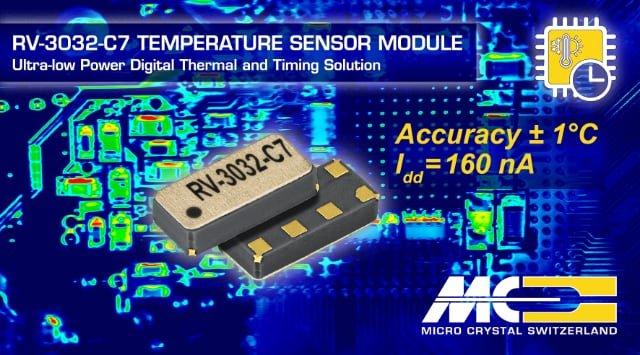
MICRO CRYSTAL Announces Ultra-Low-Power RV-3032-C7

Micro Crystal introduces the new RV-3032-C7 Temperature Sensor Module, which offers on-chip 12-bit analog-to-digital converter (ADC) providing a temperature resolution of 0.0625°C with an ultra-low current consumption of 160 nA and I2C interface. This high-performance ultra-compact module, featuring a custom IC with embedded temperature sensor, RTC functions and integrated quartz crystal resonator, sets new standards […]

continue reading

MICRO CRYSTAL’s New RV-3032-C7 High Performance Temperature Compensated Real-Time Clock Module with I2C interface

<p>Micro Crystal introduces the new RV-3032-C7 Real-Time Clock (RTC) Module, which offers the world’s best time accuracy across industrial temperature range at ultra-low current consumption.</p> <p>This high-performance ultra-compact RTC Module, featuring a custom IC and integrated quartz crystal resonator, sets new standards in <strong>smallest size</strong> (half of the footprint of a uSOP-8 package, no additional […]

continue reading

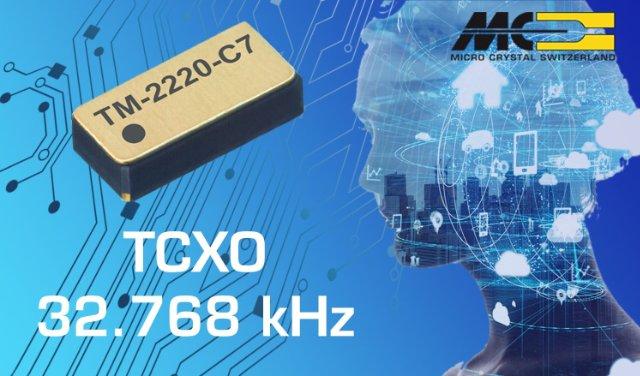
MICRO CRYSTAL’s New TM-2220-C7 Highly Stable Temperature Compensated Oscillator 32.768 kHz (TCXO) with integrated X-Tal and CMOS clock signal output

. TM-2220-C7 is a plug and play temperature compensated frequency reference for applications where reliable and accurate oscillator is needed without frequency jump. Combining minimal foot print (3.2 x 1.5 x 0.8 mm), only 4 connections and outstanding performances with 1.5 µA maximum current consumption associated to tight frequency stability of ± 5 ppm over […]

continue reading