
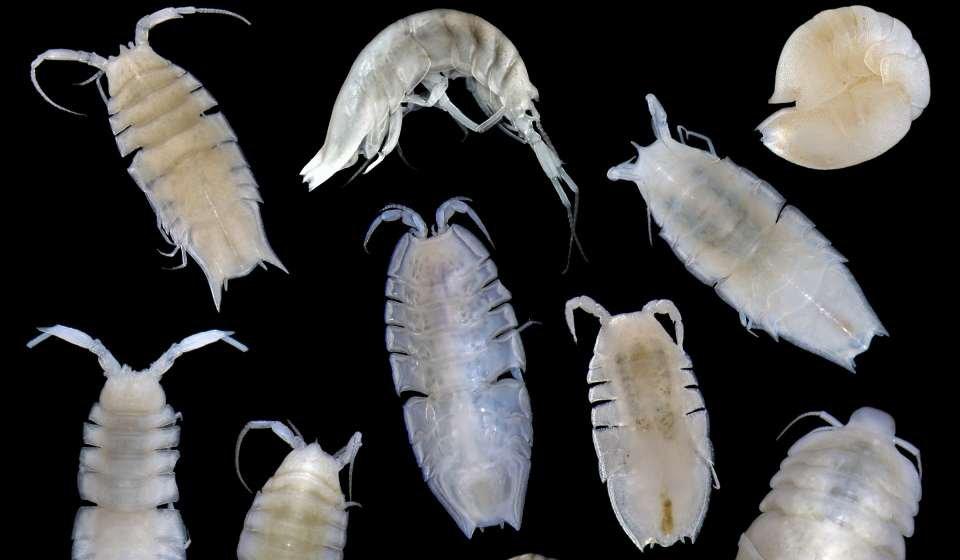
Isopods are benthic organisms that live primarily on the ocean floor, where they feed on carrion, organic detritus, or small invertebrates. The crustaceans usually move by crawling with the help of numerous segmented legs; some species can also swim short distances or are passively transported by near-bottom currents. “Due to this limited mobility, isopods living in the deep sea are generally considered to be weak dispersers. However, it is generally difficult to answer fundamental questions about the connectivity and spatial distribution of such deep-sea species due to the enormous extent of the deep-sea floor, which has been poorly studied to date,” explains Henry Knauber, the study’s first author and a doctoral student at the Senckenberg Research Institute and Natural History Museum in Frankfurt, and he continues, “It is particularly difficult to record spatial patterns of genetic differences – not only along conspicuous structures such as deep-sea trenches or oceanic ridges, but also across the vast distances of the abyssal plains that make up the majority of the deep sea. These mostly homogeneous deep-sea plains are largely free of distinctive geographical barriers and could theoretically allow bottom-dwelling animals to disperse over long distances. At the same time, however, according to biological evolutionary theories, it is precisely these large geographical distances that could represent an obstacle to genetic exchange.”
Together with Prof. Dr. Angelika Brandt and Dr. Torben Riehl, both also active at the Frankfurt Research Institute, Knauber addressed this question and investigated the biodiversity, spatial connectivity, and biogeography of deep-sea isopods. “Our focus was on species from the abyssal plains of the comparatively well-studied North Pacific, which connect the regions around the Aleutian Trench, the Kuril-Kamchatka Trench, and the Japan Trench. Our study aimed to analyze the faunal exchange between these regions and to identify possible isolation effects due to the large geographical distances,” adds Brandt.
The researchers took a closer look at two isopod families in their investigations: the Haploniscidae, which live on the sediment surface, and the Macrostylidae, which burrow in the sediment. The analyses were based on an extensive dataset containing genetic sequences from a total of almost a thousand individuals of the two families. The resulting dataset combines samples from the “AleutBio” expedition (summer of 2022, research vessel SONNE) with results from five other international deep-sea expeditions and over a decade of research in the North Pacific.
The researchers were able to detect isopods of the Haploniscidae throughout the entire North Pacific over a wide depth range – from marginal seas of the North Pacific at around 3,200 meters to the deepest parts of the Kuril Trench at a depth of almost 9,600 meters. The highest species diversity was found in the Kuril-Kamchatka region, while the number of species was lower in the Aleutian Islands and Japan regions. “The ranges of several Haploniscidae species extend over areas of several thousand kilometers in length, which is astonishing for creatures smaller than a grain of rice. In contrast, we were only able to detect one species from the Macrostylidae family with a similarly wide distribution,” says Knauber. “Our genetic analyses also revealed numerous species that were unknown to date and are barely distinguishable morphologically. Overall, thanks to several ‘cryptic’ species complexes, the biological diversity in the North Pacific is thus significantly higher than previous studies suggested,” adds Brandt.
The study also reveals considerable differences in the distribution patterns of the two families. Some species occur in all three of the regions studied and are therefore able to spread over large distances – contrary to the previous assumption that deep-sea isopods generally have limited mobility. The researchers explain the differences between the two isopod families based on their respective lifestyles: While some species live on the sea floor, others live buried in the sediment – with consequences for their dispersal and connectivity.
In some of the species studied, genetic differences also increased with increasing geographical distance, indicating “isolation by distance.” This principle of population genetics describes how gene exchange between populations decreases with increasing distance – a process that can lead to the emergence of new species in the long term. “This means that ‘isolation by distance’ could play an important role in the exceptionally high biodiversity of the deep sea. In order to understand the underlying evolutionary mechanisms that have brought about the benthic biodiversity in the deep sea, it is therefore crucial to investigate the interplay between biogeographical distribution and genetic differentiation in greater detail,” comments Knauber.
The new study shows that the biodiversity and distribution of deep-sea isopods in the North Pacific is significantly larger than previously assumed. Many species have remained undiscovered until now because they are morphologically almost indistinguishable from known species. While some species only have limited regional ranges, others are surprisingly widespread – a result that calls into question previous ideas about their ability to disperse, according to the researchers.
“Our results show once again how little we actually know about the deep sea and its inhabitants. And since many species remain undiscovered to date, it is especially important to better understand and protect these habitats. Deep-sea ecosystems are sensitive and threatened, for example by deep-sea mining, climate change, or pollution. Only if we understand the ecological interplay in the depths of the oceans can we develop effective and sensible protective measures,” adds Brandt in conclusion.
The study was published in a special volume on the “AleutBio” expedition. In the summer of 2022, an international research team sailed to the Aleutian Trench and the Bering Sea on the German research vessel RV SONNE to record the biodiversity and distribution of deep-sea fauna. This special volume documents the results of this expedition and combines historical data with new findings in order to paint as complete a picture of the deep sea as possible. The AleutBio project is part of the UN Ocean Decade for a sustainable use of our oceans and contributes to the UN’s Challenger 150 project.
Further information about the special volume at: https://www.sciencedirect.com/special-issue/102SWH217ZD
Senckenberg – Leibniz Institution for Biodiversity and Earth System Research // Senckenberg Gesellschaft für Naturforschung
Senckenberganlage 25
60325 Frankfurt
Telefon: +49 (69) 7542-0
Telefax: +49 (69) 746238
http://www.senckenberg.de
Senckenberg Forschungsinstitut und Naturmuseum Frankfurt
Telefon: +49 (69) 7542-1693
E-Mail: henry.knauber@senckenberg.de
Senckenberg Forschungsinstitut und Naturmuseum Frankfurt
Telefon: +49 (69) 7542-1240
E-Mail: angelika.brandt@senckenberg.de
Leitung Pressestelle & Social Media
Telefon: 06975421434
E-Mail: judith.joerdens@senckenberg.de
